
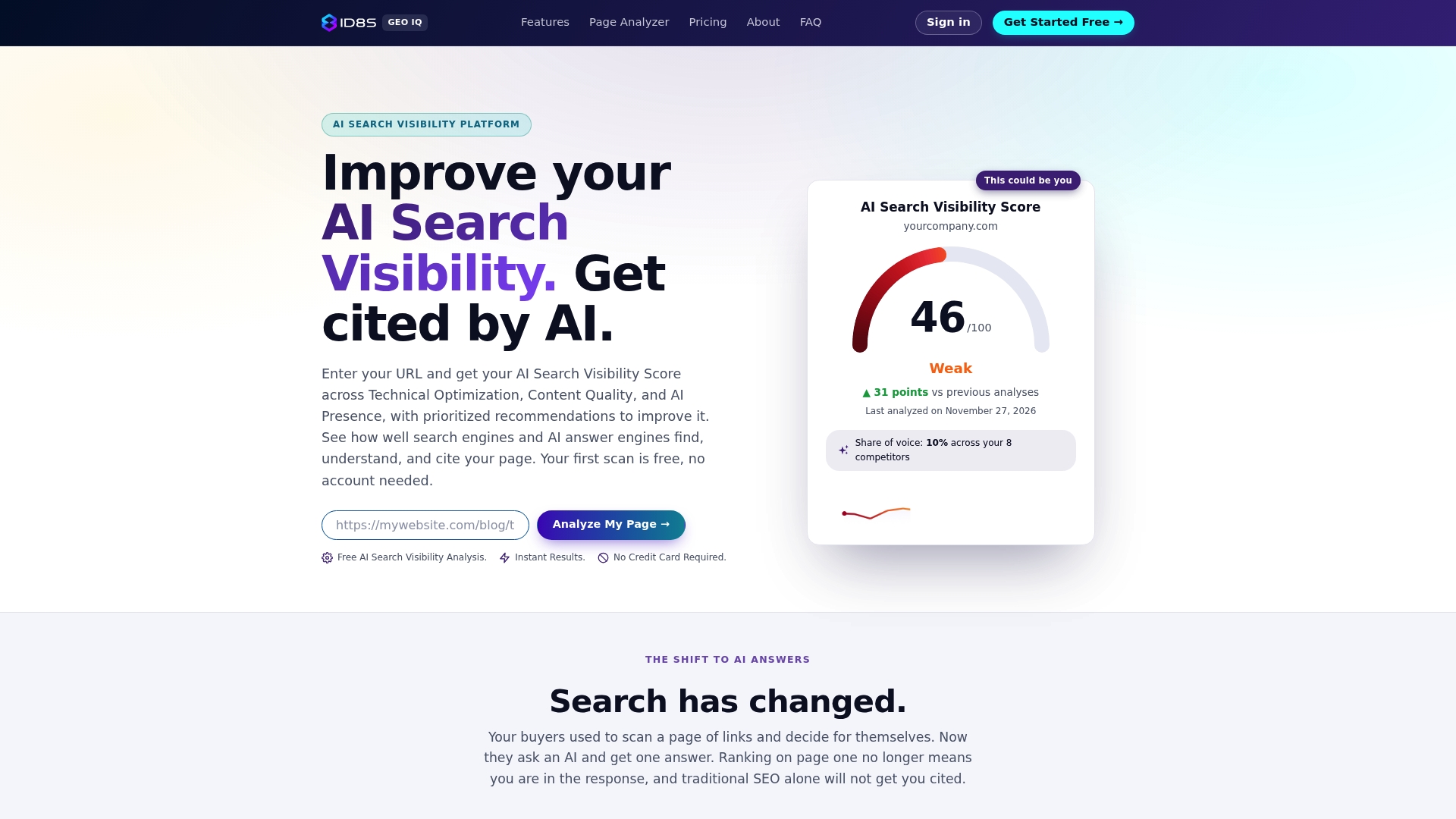
An AI visibility check answers two questions: can AI search systems reach and understand your pages, and do they mention or cite you when customers ask about your category? The first is a technical and content question you can score on a page. The second is a sampling question you track over time. Our platform, GEO IQ, scores pages on technical optimization, content quality and AI presence in one place, then turns the findings into prioritized, page-specific recommendations.
TL;DR
- An AI visibility check combines access (can AI crawlers read your page?) with presence (are you mentioned and cited in answers?).
- Share of voice is your mentions divided by all brand mentions in a defined set of prompts, so the prompt set decides the result.
- Answers change from run to run, so one snapshot misleads. Repeat the same checks on a schedule.
- Treat any visibility score as directional and compare like for like over time.
- Fix access and content first, then track citations and competitors in one workflow.
Table of Contents
- What an AI visibility check actually measures
- The two halves of a check
- How to run an AI visibility check, step by step
- Why one snapshot is not enough
- AI share of voice, explained with an example
- How to read an AI visibility score or index
- Limits to keep in mind
- Turning findings into work
- Where GEO IQ fits
- FAQ
- Sources
What an AI visibility check actually measures
Traditional search reports rankings and clicks. AI search reports something different: whether a brand appears inside a generated answer, and which sources the answer relied on. A meaningful AI search dashboard can track mentions, citations, cited URLs, share of voice, position, sentiment and prompt coverage. The same guide notes that results vary by model, prompt, location, freshness and context, and that measurement is incomplete.
It also separates two kinds of failure. A visibility gap means your brand does not appear at all. A retrieval gap means you are mentioned, but the answer cites third-party, competitor, outdated or low-quality sources. They need different fixes: the first is usually about whether your content is discoverable and answers the question, the second about which pages the model trusts.
A related distinction comes from MIT Sloan Management Review: visibility means appearing, while accuracy means being represented correctly. A good check looks at both.
The two halves of a check
Access and content: can AI systems use your page?
This half is deterministic. You can test it today and get the same answer tomorrow. It covers whether crawlers can fetch your page, whether content depends on JavaScript to render, whether AI access files and schema markup are in place, and whether the page states clear answers under substantive headings. MIT Sloan Management Review's advice for improving discovery points the same way: make content accessible to AI crawlers, surface clear answers with FAQ structure, keep content accurate, and manage credible third-party sources such as reviews and directories.
GEO IQ's analysis covers crawler and JavaScript rendering checks, AI access-file and schema analysis, and keyword checks, alongside content quality. You can see how it works on the AI search visibility analysis page.
Presence: do AI answers mention and cite you?
This half is sampled. You ask AI platforms the questions your customers would ask about your products, your category and your competitors, then record whether you appear, how you are described and which URLs are cited. MIT Sloan Management Review describes a disciplined audit as testing a fixed set of customer-like prompts on major platforms, recording errors and omissions, and tracing cited URLs back to source material.
When an answer is wrong or thin, the cited URL tells you where to look. Often it is an outdated page, a directory listing or a competitor's comparison. Correcting the source is more effective than arguing with the answer.
How to run an AI visibility check, step by step
1. Build a fixed prompt set
Write 20 to 30 questions a real buyer would ask: category questions ("best tools for X"), problem questions, comparison questions and questions that include your location if you serve one. Keep them in a spreadsheet. The set matters more than any tool, because the IAB's August 2026 framework cautions that changing the query set changes the result. Once you fix it, change it rarely, and note when you do.
2. Test the technical layer on your key pages
Pick the pages you most want cited: product pages, pricing, guides, FAQs. Check that crawlers can fetch them, that the main content appears without running scripts, and that schema and access files are present and correct. This is where most quick wins sit, because a page that cannot be read cannot be cited. Running these checks by hand across many pages is slow; a platform that scores each page and ranks the fixes saves that repetition.
3. Run the prompts on the major AI platforms
Record for each prompt and platform: mentioned or not, position in the answer, tone, and every cited URL. Note the date. Use the same wording each time.
4. Classify each miss
For each prompt where you are absent or misrepresented, decide: visibility gap (not there) or retrieval gap (there, but citing weak or outdated sources). Then trace the cited URLs. This turns a list of failures into a to-do list.
5. Fix, then repeat on a schedule
Update pages, correct third-party listings, and rerun the same set. Monthly works for most teams; weekly suits fast-moving categories or agencies reporting to clients.
Why one snapshot is not enough
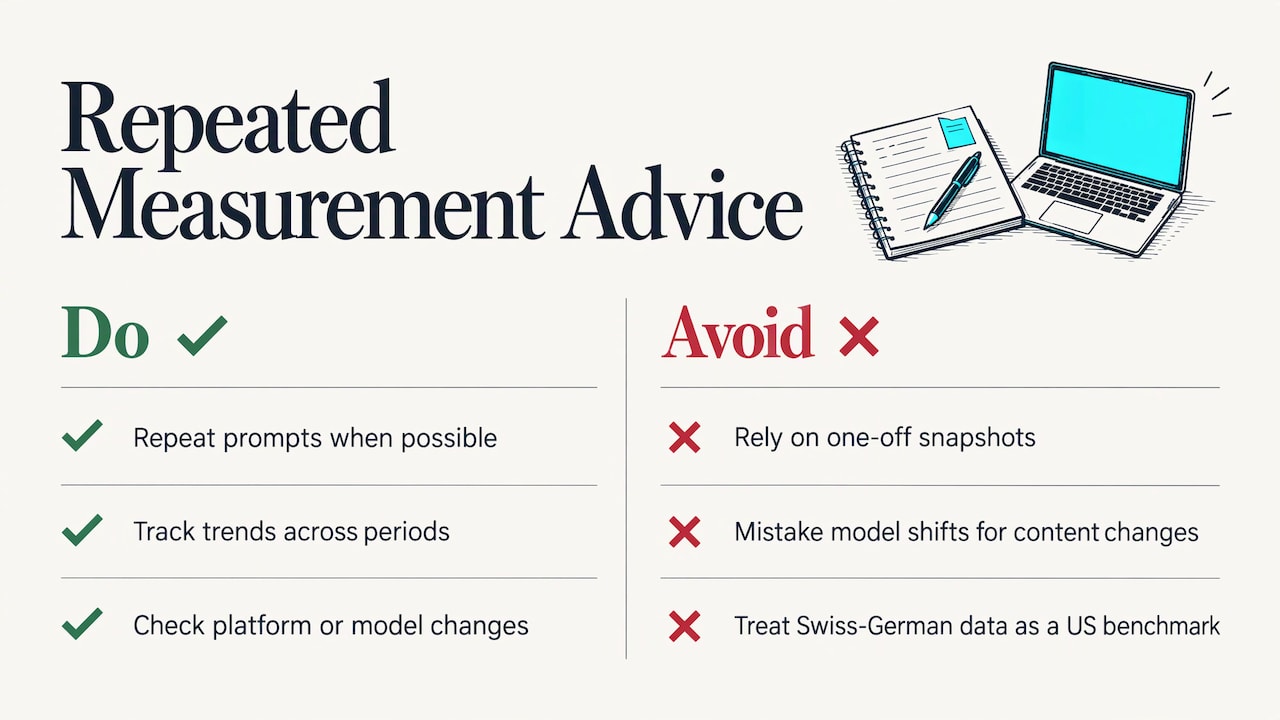
AI answers are not stable. An arXiv study published in April 2026 found that repeated identical prompts could produce substantial variation in cited sources within 24 hours, with mean source similarity between 0.321 and 0.434 across the campaigns it studied. The authors recommend repeated observations rather than a one-off snapshot. The data came from Swiss-German campaigns and may not carry over to other regions or languages, so read it as evidence that variation is real, not as a US benchmark.
Practically: run each prompt more than once when you can, look at trends rather than single results, and expect some noise. The IAB defines Visibility Momentum as the percentage change in Mention Rate or Share of Voice between periods, and warns that platform or model changes can shift the baseline. If your numbers jump after a platform update, that may be the model, not your content.
AI share of voice, explained with an example
Share of voice in AI search is your brand's mentions as a proportion of all brand mentions in a defined competitive category. The IAB's framework also defines Mention Rate: responses that mention a brand divided by total responses in a defined query set.
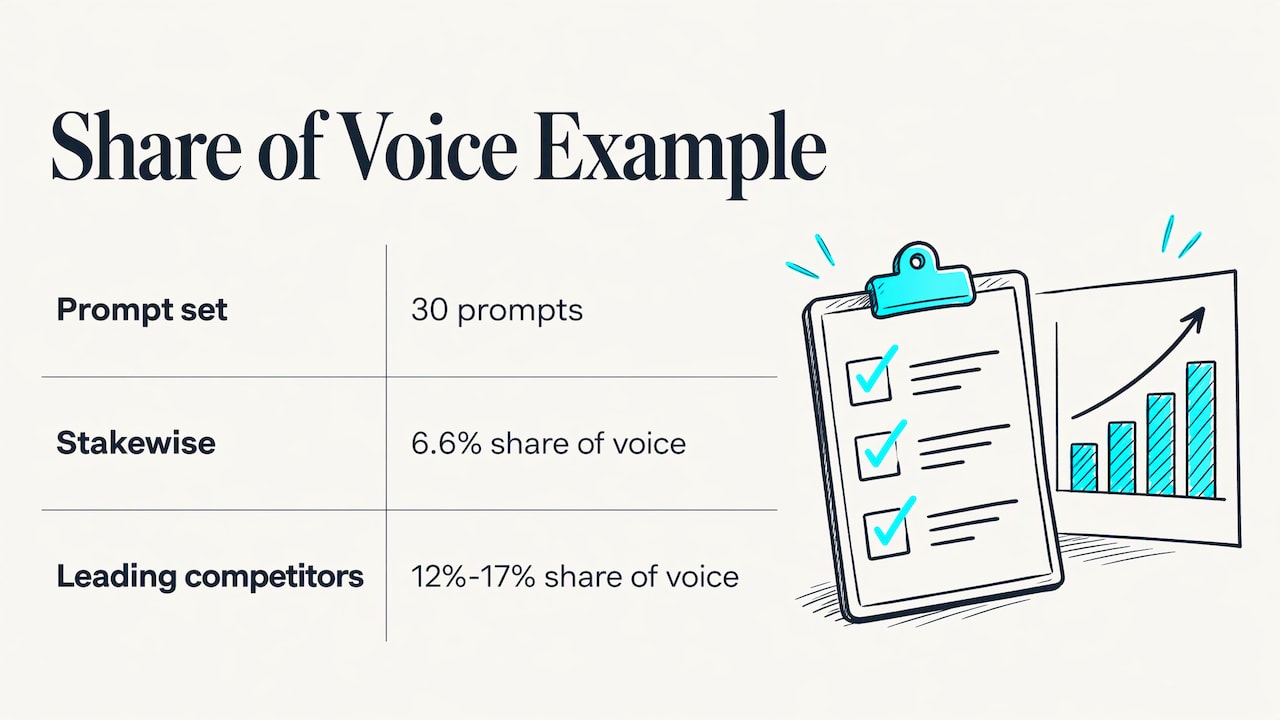
A worked example from MIT Sloan Management Review: a company called Stakewise tested 30 prompts and measured a 6.6% share of voice, against 12% to 17% for leading competitors. That figure applies to that prompt set only, not to the whole market.
Two points follow. First, you must define the category and the competitor list before you count, or the denominator is meaningless. Second, share of voice tells you where you stand relative to others, while citations tell you which of your pages earn it. Use both. For agencies, competitor tracking in the same view as the client's own pages makes the comparison repeatable across accounts.
How to read an AI visibility score or index
An index is a provider-defined summary of sampled signals. Its meaning depends on the component metrics, the sample, the weights and how the numbers are normalized. The IAB says providers should disclose those methods and the underlying component values. So:
- Treat the score as directional, not as an official or universal ranking.
- Compare the same tool, same prompts and same pages across time.
- Look at the components, not only the total. A low technical score and a high presence score call for different work.
- Do not compare scores from different tools with each other.
GEO IQ combines deterministic technical checks with AI analysis in one score, and keeps score history and trend monitoring so you can see whether your fixes moved it.
Limits to keep in mind
Measurements rely on simulated prompts that may differ from real user behavior. Answers vary between sessions, and attribution from AI answers to site visits is incomplete. MIT Sloan Management Review recommends using share of voice, citation patterns and AI-referred engagement together, because prompt samples, model variability and incomplete attribution limit precision. Brand detection can also miss synonyms or produce false positives, so spot-check your counts by reading a sample of the actual answers.
Turning findings into work
A check is only useful if it ends in changes. A workable order:
- Fix anything that blocks access: rendering, crawler rules, missing access files.
- Rewrite key pages so each opens with a direct answer, with clear headings and FAQ sections.
- Add or correct schema.
- Update third-party profiles, reviews and directory listings that AI answers cite.
- Rerun the prompt set and compare against the last run.
GEO IQ provides prioritized recommendations per page, task management to assign and close those fixes, and score history to show the result. The features overview shows what each analysis flags.
Where GEO IQ fits
If you want the technical, content and presence checks in one workflow, start with the free plan on the pricing page and analyze a page. Paid plans run Pro at $29 per month, Growth at $99, Business at $349 and Agency at $899, with Enterprise available on request. If you need extra analyses beyond your plan, one-off top-up credits cost $40 (Small), $110 (Medium), $240 (Large) or $520 (XL).
Marketers and content creators can use it to see which pages earn citations and which need work. Agencies can track competitor performance and monitor client domains over time.
FAQ
What is an AI visibility check?
It is an assessment of whether AI search systems can access your content and whether they mention or cite your brand in answers. It combines technical and content checks on your pages with sampled prompts on major AI platforms.
How often should I run one?
Regularly, on the same schedule and with the same prompts. Monthly suits most teams. Because answers vary between runs, trends over several checks tell you more than any single result.
Is an AI visibility score comparable across tools?
No. A score is a provider-defined summary, and its meaning depends on components, sample and weighting. Compare the same method over time, and read the components behind the total.
What is a good share of voice?
There is no universal benchmark. Share of voice depends on your category definition and prompt set. A useful target is to close the gap with the competitors you chose to track, measured the same way each time.
Sources
- How to build a meaningful AI search visibility dashboard (Search Engine Land)
- The New Rules of Brand Visibility in AI Search (MIT Sloan Management Review)
- Measuring Visibility in the AI Era, August 2026 (IAB)
- Don't Measure Once: Measuring Visibility in AI Search (arXiv)